
Luxembourg, August 31, 2026
NorthStar leads European Space Agency Consortium Advancing Atmospheric Re-Entry Prediction
FALCON project will mitigate threats from space debris in Very Low Earth Orbit (LEO)
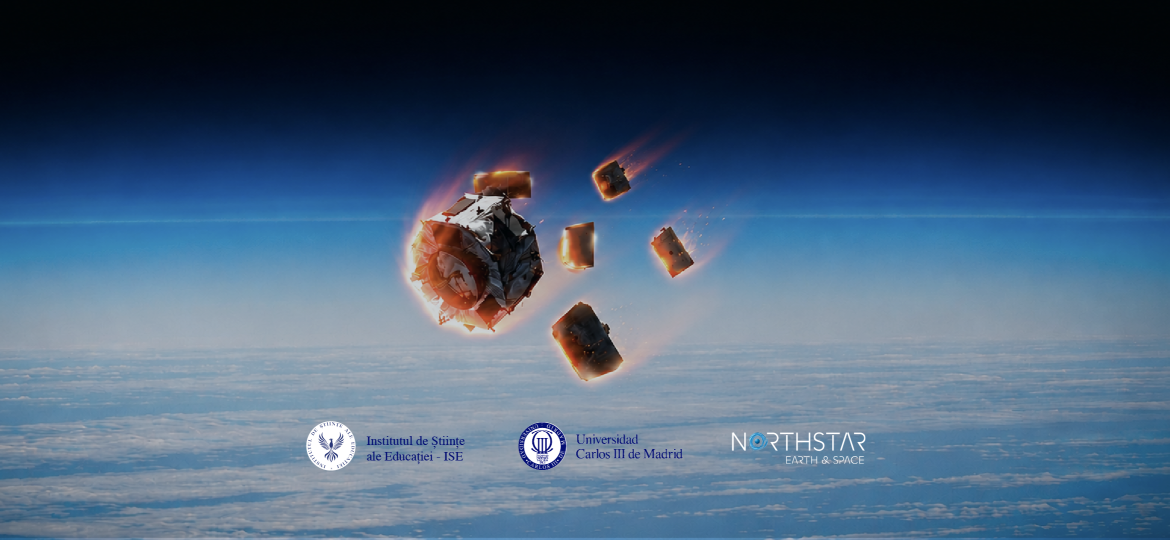
Luxembourg – August 31, 2026 – NorthStar Earth & Space S.à r.l. (“NorthStar Europe”), a global leader in commercial Space Domain Awareness (SDA), has been selected by the European Space Agency (ESA) to lead the Forecasting of Atmospheric Location and Chronology of Re-entry (“FALCON”) initiative to improve predictions of the location and timing of uncontrolled objects as they re-enter Earth’s atmosphere.
The re-entry of space objects into the Earth’s atmosphere is one of the most consequential events in the lifecycle of any satellite or orbital structure. Through the FALCON project, NorthStar and its consortium partners will assess the limitations of uncontrolled atmospheric re-entry predictions by developing a more reliable framework for generating precise, probability-based forecasts of re-entry time and location. The project underscores NorthStar’s commitment to advancing European space capabilities while leveraging its expertise in orbital dynamics to deliver greater confidence across the mission lifecycle, from launch to de-orbit.
“FALCON represents an important dimension of European innovation focused on practical solutions to support space safety and responsible operations. NorthStar is proud to lead such an initiative that will enhance vital operational information to satellite operators,” said Manuel Sanjurjo Rivo, Orbital Dynamics Team Lead at NorthStar. “By combining advanced analytics, atmospheric modeling, and operational expertise, we are helping to build a more secure space environment for governments, commercial operators and citizens.”
Increased launch activity introduces more challenges from uncontrolled re-entries as recently demonstrated by rocket debris recovered in Poland in 2025 and manifested by airspace restrictions in Spain stemming from uncertainty with a large rocket re-entry. Through this ESA project, NorthStar and its consortium partner institutions will advance the understanding and quantification of the atmospheric properties of Very Low Earth Orbit. The consortium will improve orbital dynamics modeling to produce a probability distribution of the re-entry window, contributing directly to European and global efforts to improve space traffic management, debris mitigation, and public safety, benefiting civil, defence and commercial stakeholders.
“The Agency has been actively studying the dynamics of re-entry events to improve predictions, and to mitigate risks of uncontrolled re-entries,” said Tim Flohrer, Head of the Space Debris Office at ESOC in Darmstadt. “This project represents an important initiative in ongoing efforts to enhance the safety and predictability of re-entry events.”
The project consortium includes
- Universidad Carlos III de Madrid (UC3M, Spain) — Contributes world-class expertise in computational statistics, Bayesian inference, Gaussian process modelling, and uncertainty quantification for orbital dynamics. UC3M led the ESA UNCPROP project, which pioneered probabilistic re-entry time window estimation.
- Institutul de Științe Spațiale (ISS, Romania) — Contributes physics-based modelling of the thermosphere-ionosphere with data assimilation and operates the FORIND forecasting service as part of ESA’s Space Weather Service Network.
- NorthStar Europe — Leads the project, contributing operational experience in astrodynamics methods, conjunction analysis, and space situational awareness solutions. NorthStar’s Conjunction Analysis System is currently operational and is advancing space safety throughout Europe and globally.
The three organizations are also collaborating on the ESA Robust Atmosphere Error Modelling for Sustainable Operations (“RAPTOR”), providing an established technical foundation and collaborative infrastructure for FALCON.
About NorthStar Earth & Space
NorthStar has been launching dedicated space-based sensors that continuously scan, detect, and track the behaviour of satellites from space. NorthStar offers commercial and defence customers 24/7 Space Situational Awareness (SSA) and Space Domain Awareness (SDA) services.
NorthStar’s patented Space Information & Intelligence (Si2) Platform combines a resilient system architecture, enabling real time SDA, by leveraging intersatellite links, AI, and edge computing. By fusing diverse observation sources with its dedicated sensors, the real-time system detects threats as they occur and evolve in-orbit. This highly differentiated service provides early detection, tracking, and custody of emerging space threats to enable decision makers to measure and assess alternative responses.
With global headquarters in Montreal, Canada, a European HQ in Luxembourg, and a dedicated U.S. operation in Virginia, NorthStar supports mission critical operations with key defence and civil clients including the Royal Canadian Armed Forces’ (RCAF) – 3 Canadian Space Division (3 CSD), the US Space Force Joint Commercial Operations, DARPA, the Luxembourg Space Agency, and the European Space Agency and others.